Abelia chinensis

Warning message

The onboarding status of your Mollie account could not be determined. Click to configure your Mollie account. This needs to solved before payments can be received using Mollie.

Suppress warnings about Mollie configuration.
Famille: 
Caprifoliaceae

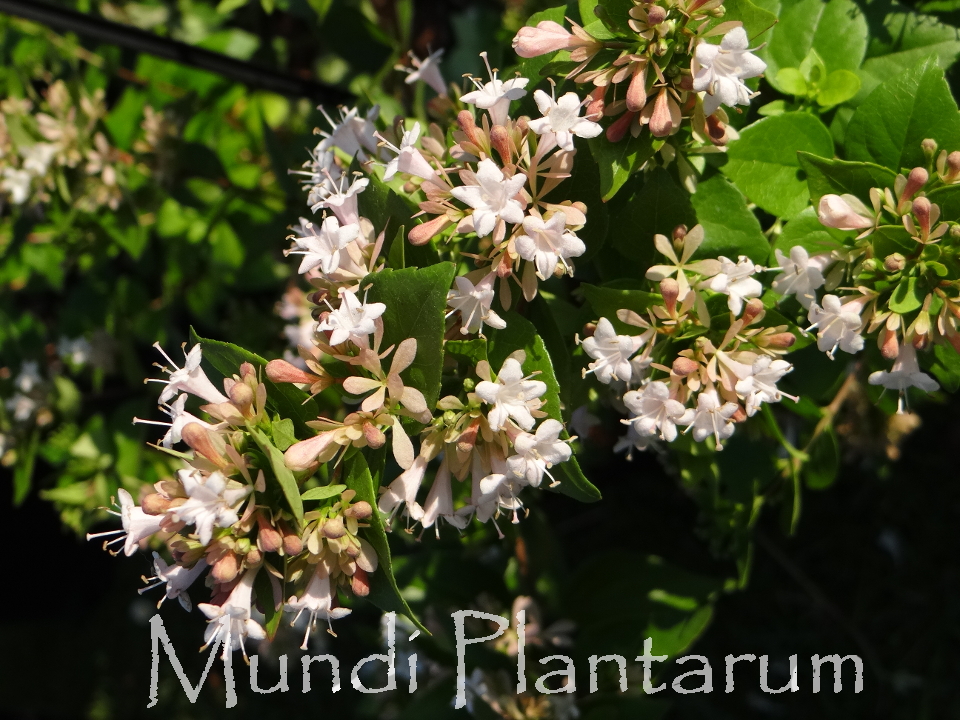
Rounded shrub with arched and supple twigs. Semi persistent. White fragrant flowers in summer. Height 1 to 1,5m.
 

Classification

Trees and shrubs

Climat

Zone 8: from -12°C to -7°C

Couleur de feuille

  • Cardinal red
  • Green

Couleur de fleur

  • White
  • Pink

Exposition

  • Sheltered winds
  • Sunny

Taille

100 to 150cm
1 to 2m

Intérêts remarquables

  • Foliage
  • Flower
  • Perfume

Plante intéressante

  • In summer
  • In autumn

Type de sol

  • Acidic

Utilisation au jardin

  • Hedge
  • Massif
  • Parterre

GENERAL DESCRIPTION

  • ORIGIN: Central and Eastern China in temperate regions. The Abelia was discovered by British Doctor Clarke Abel in 1816-17. The new genus Abelia was created in 1825 following this discovery. Introduced into culture in 1844.
  • CLIMATE: Resistant to -10 ° C. One of the most hardy in the species.
  • EXPOSURE: Sunny.
  • SOIL: Well drained, slightly acid. This plant is resistant to drought.
  • GROWTH: Normal to fast.
  • Pathology
  • MULTIPLICATION: By herbaceous cuttings in July-August.
  • Use: Hedge, boarder or isolated.
  • Mérit: Award of Merit 1976 (RHS).
  • SYNONYMOUS:

GENERAL PHYSIOLOGY 

  • DIMENSIONS: Can reach up to 1.5m to 2m in good conditions, height as width.
  • HABIT: Its port is at the same time bushy and flared, supple and dense.
  • Trunk: Multi stems and bushy.
  • BARK: Light brown to olive green, vertically rift, exfoliating with age. Branches finely pubescent reddish.
  • Branches: Woody and cylindrical rods.
  • Note:

LEAVES PHYSIOLOGY

  • SHAPE: Single sheet, opposite; pennate; blade lanceolate and toothed; pointed top; cuneiform base.
  • COLOR: Shiny green that becomes purple bronze in autumn.
  • Buds:
  • Note: Deciduous or semi-persistent, even persistent in mild climate.

FLOWERS PHYSIOLOGY

  • DATE: July-August and can sometimes reach October.
  • SHAPE: In corymbe of tubular flowers terminated in 5 lobes, length of a flower: 2cm.
  • COLOR: White tinged with pink, rosy calyx.
  • NOTE: Perfumed flowering, capable of embalming a whole garden in hot weather. Melliferous.

FRUITS PHYSIOLOGY

  • SHAPE: Akene, indehiscent dry fruit. It does not open to maturity. Insignificant.
  • COLOR: Green to beige.
  • SEEDS: One seed per fruit.
  • Note: